What evidence is required?
When applying for certification to complete the programme, the evidence you are required to submit depends on the pathway and specialty you have chosen to follow.
Your evidence will include some or all of the following:
- Successful completion of the Doctor of Clinical Science (DClinSci) in its entirety or component parts dependent on pathway.
- Completion of an Innovation Proposal and lay presentation project (all trainees).
- Research project or evidence of exemption by virtue of a relevant and timely PhD.
- Successful completion of the Fellowship of the Royal College of Pathologists (Life Science only).
- Successful completion of CEng (Clinical Biomedical Engineering only).
- Successful completion of the Independent Assessment of Practical Skills (Physical, Physiological Sciences and Bioinformatics only).
- Work-based evidence demonstrating the appropriate application of specialty knowledge and skills, through the quality and types of evidence. Submitted to OneFile e-portfolio and appropriately mapped to the domains of the AHCS Standards of Proficiency for Higher Specialist Scientists and to the learning outcomes of the specialist curriculum (all trainees).
- Engagement with the Annual Review of Progression (all trainees).
- Sign-off by the work-based Supervisor as meeting the requirements of the Higher Specialist Scientist Training programme (all trainees).
Evidence required for Life Science pathways
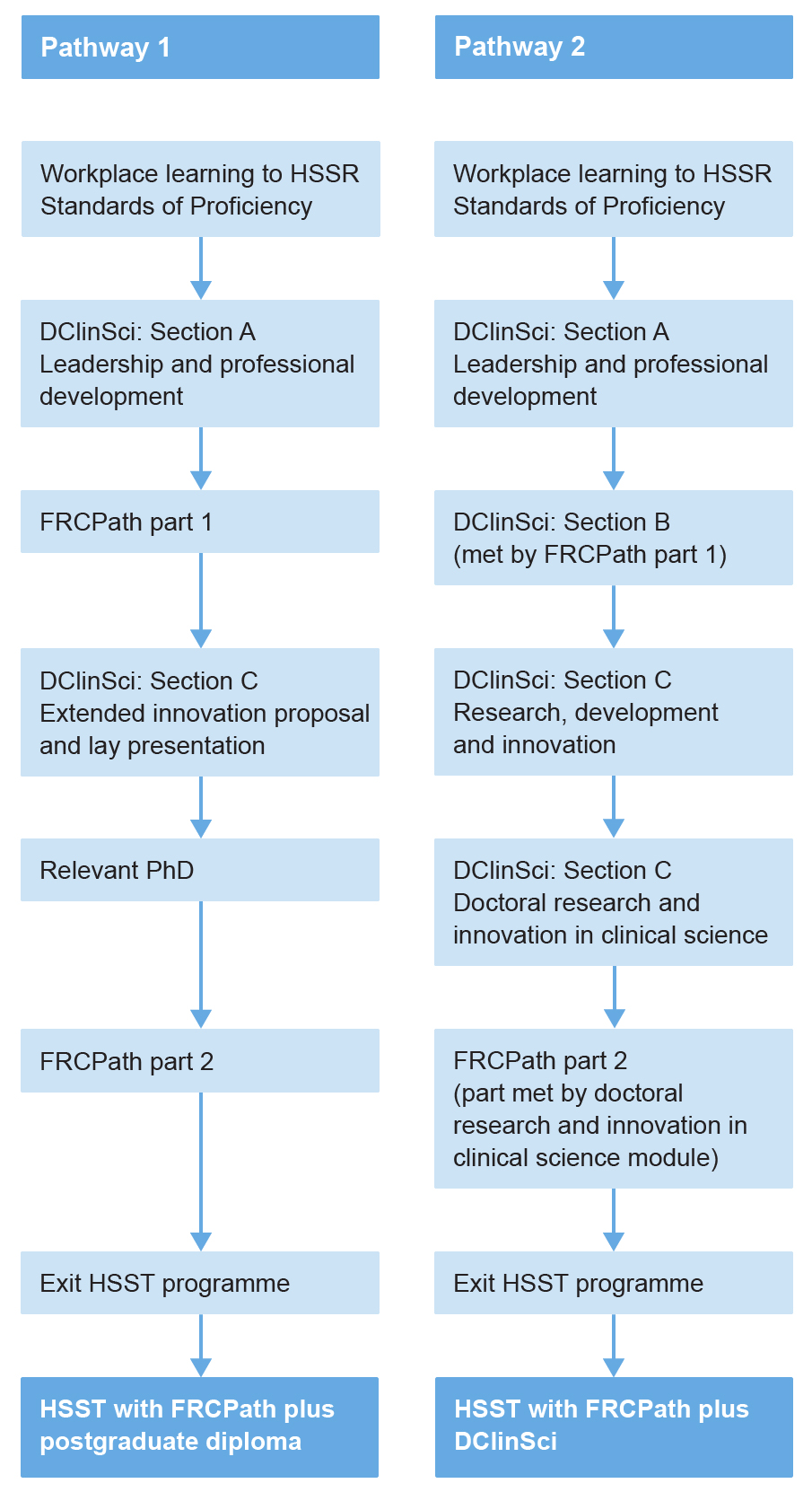
Pathway 1 – HSST with FRCPath and Postgraduate Diploma
Successful completion of:
- Fellowship of the Royal College of Pathologists
- DClinSci – Section A: Leadership and Professionalism for Healthcare Sciences
- DClinSci – Section C: Innovation module and lay presentation
- Exemption from Section C research module by a relevant and timely PhD
- E-portfolio of evidence
- Sign-off by work-based Supervisor
- The Annual Review of Progression
With completion of:
- Postgraduate Diploma (Leadership and Professionalism for Healthcare Sciences)
Pathway 2 – HSST with FRCPath and Doctor of Clinical Science (DClinSci)
Successful completion of:
- Fellowship of the Royal College of Pathologists
- DClinSci – Section A: Leadership and Professionalism for Healthcare Sciences
- DClinSci – Section C: Innovation module
- DClinSci – Section C: Research module
- E-portfolio of evidence
- Sign-off by work-based Supervisor
- The Annual Review of Progression
With completion of:
- Doctor of Clinical Science
Evidence required for Physical and Physiological Science pathways
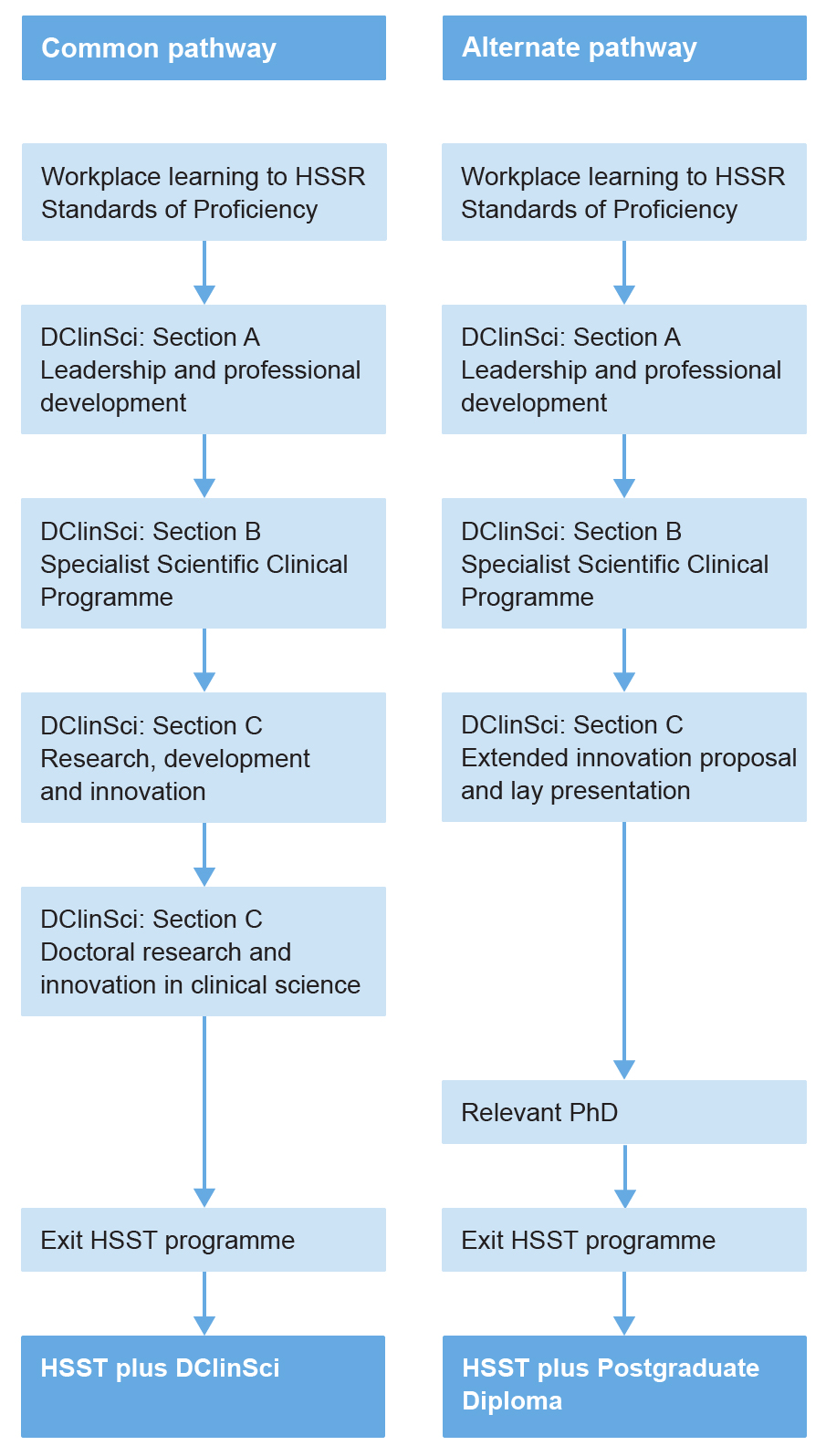
Common path – HSST with Doctor of Clinical Science (DClinSci)
Successful completion of:
- Doctor of Clinical Science comprising:
- DClinSci – Section A: Leadership and Professionalism for Healthcare Sciences
- DClinSci – Section B: Specialist modules
- DClinSci – Section C: Innovation module
- DClinSci – Section C: Research module
- Independent Assessment of Professional Skills (IAPS) pass including completed e-portfolio
- Sign-off by work-based Supervisor
- The Annual Review of Progression
Alternate pathway – HSST with Postgraduate Diploma
Successful completion of:
- Postgraduate Diploma (Leadership and Professionalism for Healthcare Sciences)
- DClinSci – Section A: Leadership and Professionalism for Healthcare Sciences
- DClinSci – Section B: Specialist modules
- DClinSci – Section C: Innovation module
- Exemption from Section C research module by a relevant and timely PhD
- Independent Assessment of Professional Skills (IAPS) pass including completed e-portfolio
- Sign-off by work-based Supervisor
- The Annual Review of Progression
Equivalence applications
Trainees should be aware that equivalence applications cannot be undertaken concurrently with the Higher Specialist Scientist Training programme. Further guidance on equivalence is available on the Academy for Healthcare Science website.
How do I get my HSST Completion Certificate?
Once you have passed your final assessment, completed all of the HSST elements and received your academic qualification certificate, you can apply to complete the HSST programme. This is done via the HSST completion form on OneFile. You must complete this form and attach any relevant evidence.
You will receive a huge congratulations from us and your HSST Completion Certificate which can be used to join the Higher Specialist Scientist Register with the Academy for Healthcare Science.