How does our mind work and how can it lead to bias?
A simple analogy for understanding how our minds work is to think of them as being made up of lots of pockets of information. We can think of our mind placing every experience we have into a specific pocket. Our mind is always hard at work categorising our experiences and sorting them into different pockets while we carry on with our everyday lives.
This process begins in childhood. It is one of the ways we make sense of the world around us and learn how to respond when we have similar experiences in the future. Our mind naturally groups certain experiences together based on what we thought, how we felt, and how we behaved during those experiences.
This happens automatically because our brain has so much information to process, and we need a way of dealing with it all without having to consciously think about everything. It can be a very efficient, unconscious shortcut. The less conscious parts of our mind help us do this by giving us access to this information when we need it to make decisions.
However, this process can also create a problem. It means we make choices in the present that are influenced by our past experiences.
Even though we may be unaware that our mind is helping us make decisions in this way, this process can shape our biases towards certain people, places, and situations, both positively and negatively.
This is why it is important to understand bias and to make our unconscious biases more conscious. Doing so enables us to reflect on them, challenge them where necessary, and reduce their potential to influence our decision-making unfairly. The more we understand and reflect on our biases, the more likely we are to make fairer decisions.
Activity
Watch these videos that help explain what happens inside your mind.
externalHow does bias work?
Positive bias occurs when we feel something matches our own thoughts and ideas or is familiar to us, and we are naturally drawn to it. Negative bias, on the other hand, occurs when something is different from what we are familiar with or from what we think is best or normal.
There are many other factors, beyond our own past experiences, that can play a part in forming our biases. For example, the way in which certain situations, issues and groups are routinely framed and described in the media can influence the way we interpret the world.
A bias can lead us to think that someone is less capable or trustworthy, or it can generate something as subtle as feeling uncomfortable around a certain person. However, it is important to remember that biases are based on previous experiences or other influences, rather than on the situation directly in front of us.
For example, we may have worked with people who have religious beliefs that are different from our own, who belong to a different age group, who have a lot of tattoos, who wear a certain type of clothing, who speak differently from us, who have a different skin colour, or who come from an entirely different culture.
Without us realising it, as part of processing previous experiences, our mind may have automatically made a connection between one or more of these characteristics and a previous experience, storing that connection in our memory. This may lead us to develop an unconscious bias for or against a person we encounter in the future. This could be a colleague at work or a candidate in an assessment or recruitment process. Our biases, based on connections formed through previous experiences, can influence what we think about people and how we respond to them, regardless of their individual skills and capabilities.
The cycle of socialisation
Alongside this analogy of the mind processing experiences into pockets and potentially creating biases we may not be aware of, it is useful to think more broadly about other ways in which behaviours, attitudes and biases can be generated and upheld. Harro’s (1982) model of the cycle of socialisation helps us understand a wide range of ways in which social, cultural and institutional factors can shape and support certain ways of seeing and behaving in the world. Harro’s cycle suggests that we can be socialised to play certain roles, that attitudes and behaviours and outcomes can be influenced by the unequal distribution of power and by personal and collective reluctance to break such cycles.
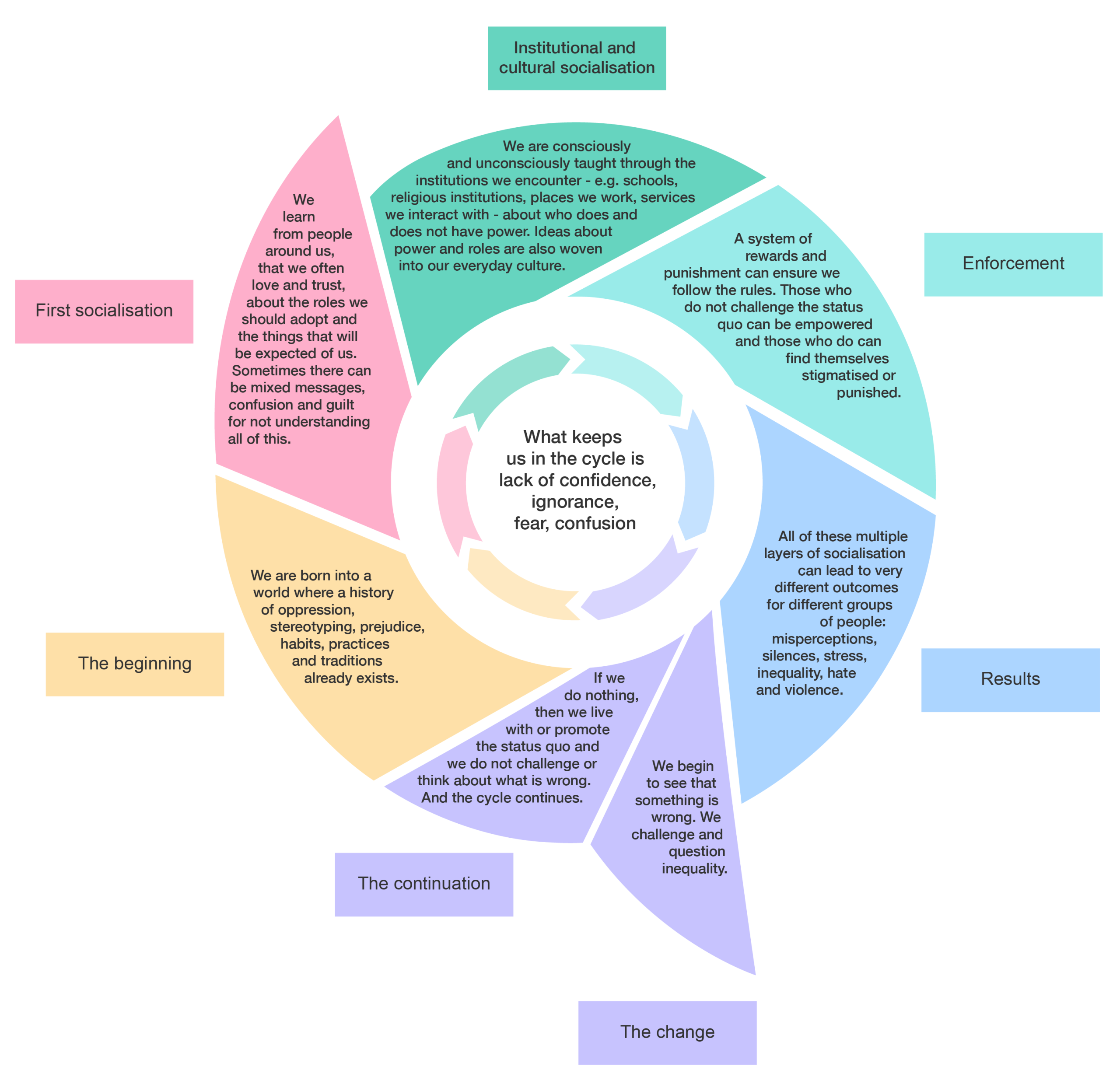
Graphic showing the cycle of socialisation
Click to read the image transcript
The beginning
We are born into a world where a history of oppression, stereotyping, prejudice, habits, practices and traditions already exists.
First socialisation
We learn from people around us, that we often love and trust, about the roles we should adopt and the things that will be expected of us. Sometimes there can be mixed messages, confusion and guilt for not understanding all of this.
Institutional and cultural socialisation
We are consciously and unconsciously taught through the institutions we encounter – e.g. schools, religious institutions, places we work, services we interact with – about who does and does not have power. Ideas about power and roles are also woven into our everyday culture.
Enforcement
A system of rewards and punishment can ensure we follow the rules. Those who do not challenge the status quo can be empowered and those who do can find themselves stigmatised or punished.
Results
All of these multiple layers of socialisation can lead to very different outcomes for different groups of people: misperceptions, silences, stress, inequality, hate and violence.
The change
We begin to see that something is wrong. We challenge and question inequality.
The continuation
If we do nothing, then we live with or promote the status quo and we do not challenge or think about what is wrong. And the cycle continues.
The core
What keeps us in the cycle is lack of confidence, ignorance, fear, confusion.
Activity
Watch these videos about trying to understand how culture drives behaviour and understanding ‘white privilege’.
externalConscious Inclusion by National School of Healthcare Science is licensed under a Creative Commons Attribution-ShareAlike 4.0 International License.